Who this is for: Jira site administrators. Do this first. Nobody can start a readiness assessment until at least one template exists.
Open Jira Settings → Apps → Service Transition & Readiness. The page has two tabs: Templates and Settings.
If you are not a Jira administrator you can still open this page, but everything is read-only and a banner says so. The same is true for everyone if the app licence is inactive.
Readiness templates
A template is the checklist a service is judged against: categories, and within each category the criteria and their weights.
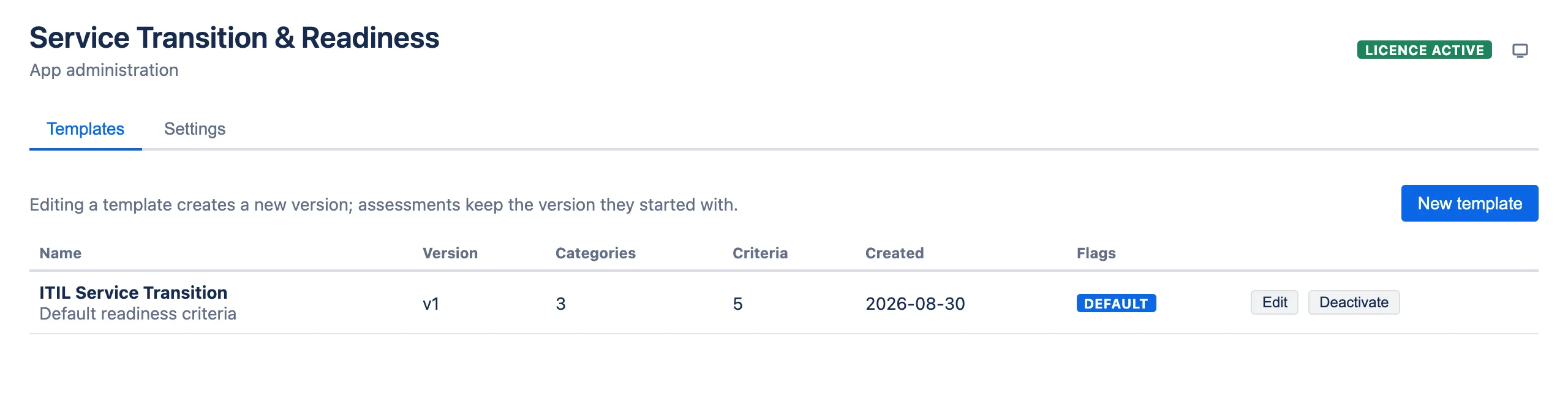
Each row shows the template’s version, its category and criterion counts, when it was created, and a lozenge when it is the default (the one pre-selected when someone starts an assessment) or when it has been deactivated. An active template carries no lozenge. Inactive templates are hidden from the picker but keep working for assessments already using them.
Creating a template
- Click New template.
- Give it a name, and optionally a description. The save button stays disabled until the name is filled in.
- Edit the starter set. A new template is not blank — it opens pre-populated with five categories and eleven weighted criteria as a starting point. Delete what does not apply, reword what does, and adjust the weights.
- Add anything missing with + Category and + Criterion.
- Click Create template.
Your real first task is pruning, not building. The starter set is a prompt, not a recommendation.
For each criterion you set:
| Field | Meaning |
|---|---|
| Criterion | The question being asked. Write it so “100%” is unambiguous. |
| Weight | 1–10. How much this criterion moves the overall score. |
| Evidence required | Shows a red Evidence required note on the criterion until a link is entered. It does not block scoring or a gate decision. |
| Mandatory | Marks the criterion with * in the assessment. It does not block a gate decision — it makes an omission visible to whoever decides. |
Use the ↑ and ↓ buttons to order categories and criteria. Order is
presentation only; it does not affect the score.
Two rules trim the template when you save:
- A criterion with no text is dropped. Its weight and checkboxes are ignored.
- A category with no name is dropped, along with anything inside it.
The second one would lose work, so the app refuses the save instead: if an unnamed category still holds criteria you have written, the name field is marked and a banner tells you how many criteria are at stake. Name the category and save again. An unnamed category that is genuinely empty is dropped quietly, which is what you want after pruning the starter set.
Removing a category deliberately does prompt you, naming how many criteria go with it. Removing a criterion that has text prompts too; an empty row goes without ceremony.
Limits: a template needs at least one category and at least one criterion, and allows at most 20 categories and 200 criteria. Weights must be 1–10.
The editor does not enforce any of these as you type — the save fails with a validation message instead. A cleared weight box reads as 0 and is rejected on save, and the two limits you are most likely to hit are the minimums, after pruning the starter set too hard.
How weights turn into a score
Each criterion is scored in five steps — 0%, 25%, 50%, 75%, 100% — and the overall readiness score is the weighted average across all of them.
A worked example. Suppose a template has three criteria:
| Criterion | Weight | Scored |
|---|---|---|
| Runbook published | 5 | 100% |
| On-call rota agreed | 4 | 75% |
| Knowledge articles published | 3 | 25% |
The score is (5×100 + 4×75 + 3×25) ÷ (5+4+3) = 875 ÷ 12 = 72.9%.
Category scores use the same formula within each category. The overall score is not an average of the category scores — a category with one criterion does not count as much as one with ten.
An unscored criterion counts as 0%, not as “not applicable”. This is the single most important consequence of template design: every criterion you add drags an in-progress assessment down until someone scores it. A 40-criterion template will sit red for weeks.
The other practical consequence: weight is how you express what actually matters. Three weight-1 criteria will not outvote one weight-5 criterion.
Editing a template — versioning
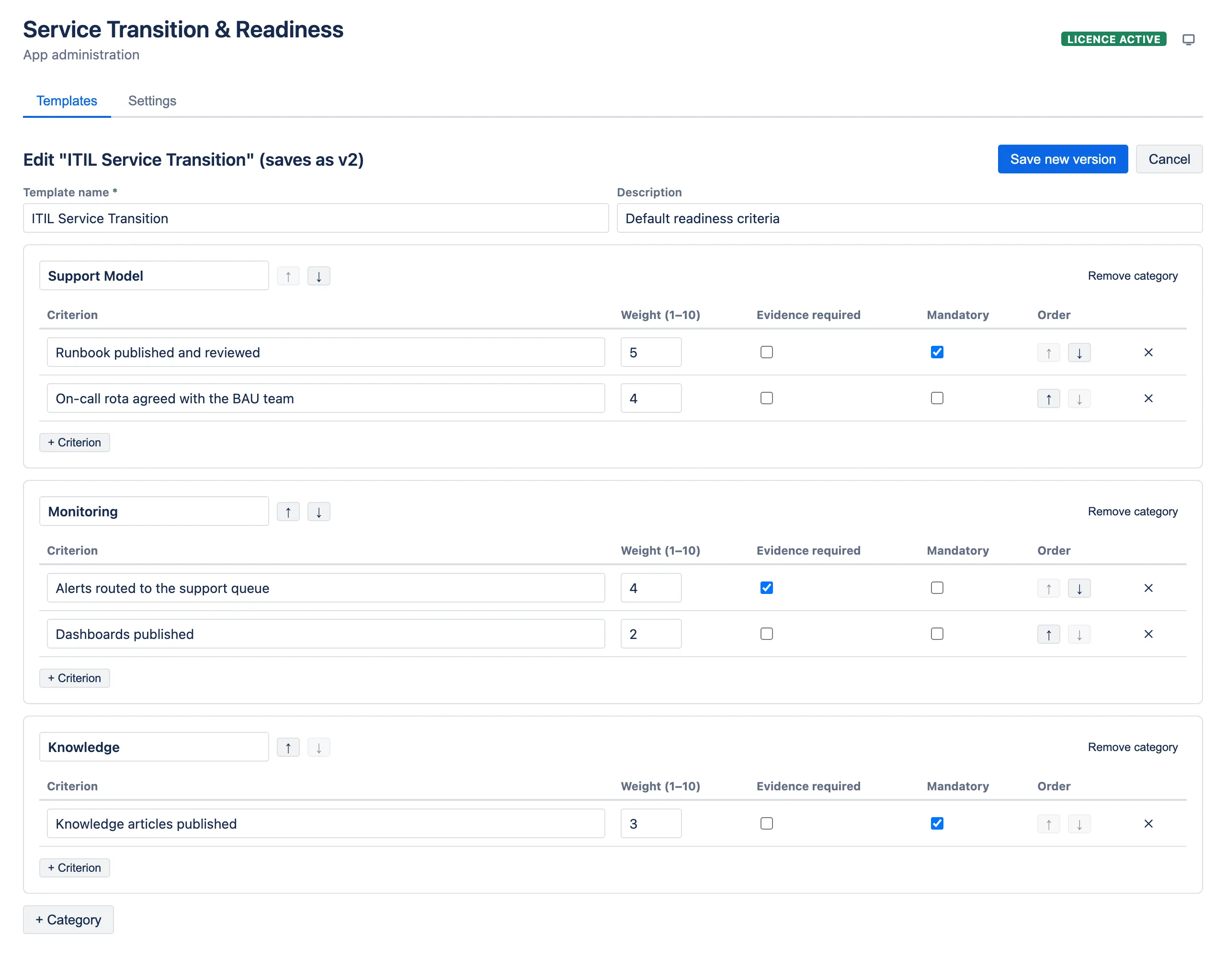
Saving an existing template creates a new version rather than overwriting the old one, which is why the editor’s heading reads saves as v2 and its button reads Save new version. The previous version is retained and marked not-latest.
This matters because assessments pin the version they started with. A gate decision recorded at 72.9% against v1 still means 72.9% against v1, even after you publish v2 with different weights. In-flight assessments are never disturbed by a template edit.
Default and active
-
Set default — pre-selects this template when someone starts an assessment. Setting a new default clears the flag from the previous one, so there is never more than one. Until someone sets it there are none. There is no way to clear the flag outright: the button is hidden on the template that already holds it, so a default can only be moved.
Deactivating the default does not clear its default flag. You end up with a default nobody can pick, and the assessment picker quietly pre-selects the first active template instead. Move the default to an active template before retiring the old one.
-
Deactivate / Activate — a toggle. Deactivating hides the template from the picker without affecting assessments already using it; activating brings it back. Use it to retire a template.
Settings
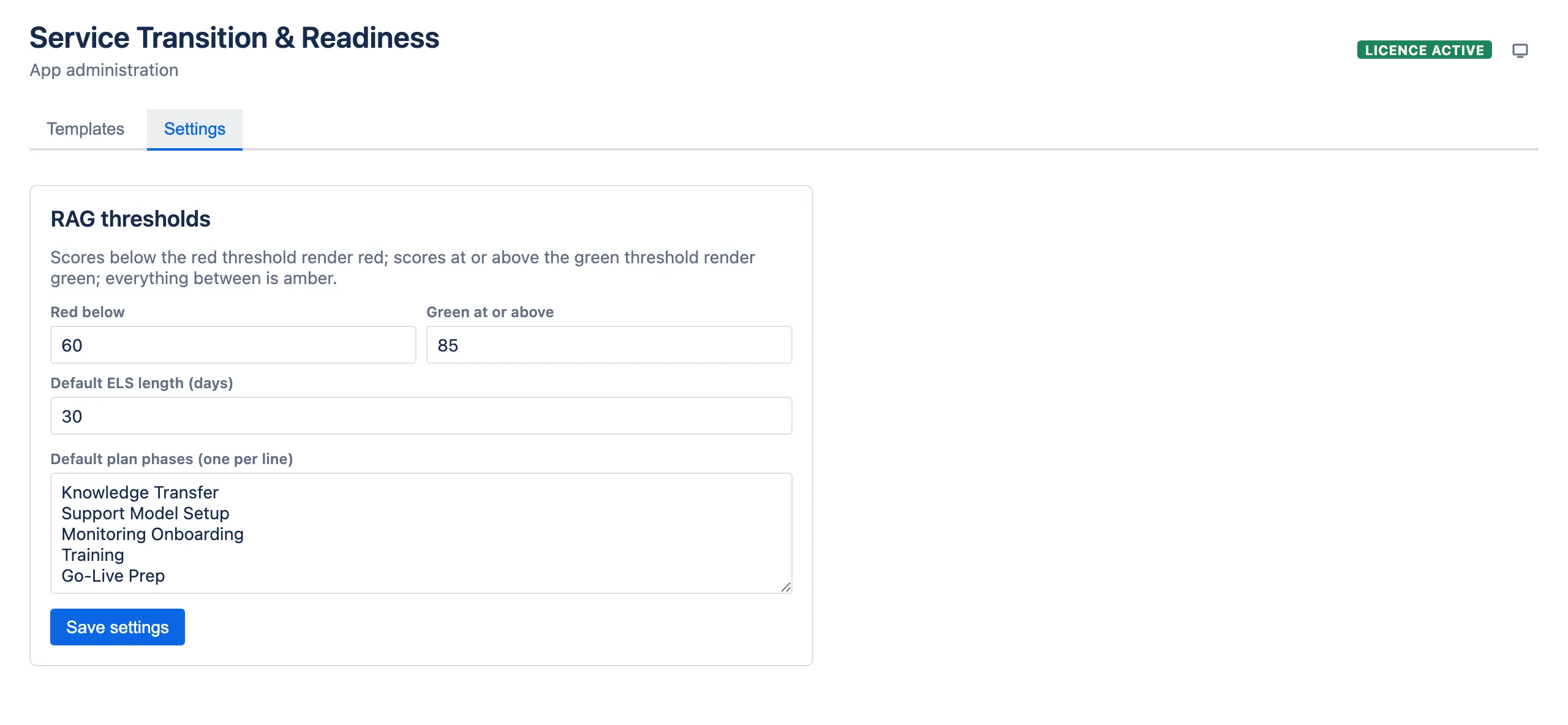
RAG thresholds
Two numbers that turn a readiness percentage into a colour:
- Red below — scores under this are red. Default 60.
- Green at or above — scores at or over this are green. Default 85.
- Everything between is amber.
Both must sit between 0 and 100, and red must be below green. The app blocks the save otherwise, because crossing them leaves no amber band at all — every score would come out red or green.
Changing these re-colours every existing score immediately. It does not change any score, and it does not change any gate decision that was already recorded — those keep the score they were made on.
Default ELS length (days)
How long an early-life support period runs by default, 1–365. Default 30. This only pre-fills the end date when someone starts ELS; they can change it.
Default plan phases
The phases a new transition plan starts with, one per line. The shipped default:
Knowledge Transfer
Support Model Setup
Monitoring Onboarding
Training
Go-Live Prep
Between 1 and 20 phases — emptying the box entirely makes the save fail. Changing this affects new plans only; existing plans keep the phases they have, and a plan can grow past 20 phases because the limit applies here, not there.
Click Save settings. A “Saved.” confirmation appears beside the button.
What to set up first
For a first rollout:
- Open a new template and cut the starter set down to what your organisation actually judges readiness on. Resist making it exhaustive — remember every criterion counts as 0% until scored, so a 30-criterion template that nobody completes reads worse than a 12-criterion one that gets filled in.
- Set it as the default.
- Check the RAG thresholds match what your governance forum expects “green” to mean.
- Adjust the default phases to your transition process.